The Two-Anchor Day: Why a Pair of Plans Can Be Enough
A two-anchor day gives a weekend direction without turning it into an itinerary. Choose two fixed plans that fit your energy, travel and budget.

A two-anchor day gives a weekend direction without turning it into an itinerary. Choose two fixed plans that fit your energy, travel and budget, then let the day take its shape from those commitments rather than from the empty boxes on a calendar.
The idea is not to preserve a large block of unclaimed time. It is to make two decisions that are worth organizing around. One can be the main event; the other can provide a change of setting, company or pace. The rest of the day can be ordinary life, including lunch at home and the bus ride between neighborhoods.
Two anchors are two different reasons to leave the house
An anchor has a definite start or meeting point: a matinee, a friend’s scheduled visit, a class, or a reservation. It is more concrete than “get outside” and less demanding than a string of stops with a shared calendar invitation.
Give each anchor a distinct job. One might be the day’s main treat; the other might be a low-key commitment that makes the day feel social or purposeful. Two events that both require dressing up, crossing town and staying alert may be less appealing together than either one alone.
There is no requirement to use exactly two. One fixed plan can be enough on a demanding weekend. A third makes sense if it is genuinely important, not merely because the day looks sparsely populated in Google Calendar.
Choose plans that fit your budget and energy
Decide what the day can comfortably ask of you before choosing activities. A paid event may be the main anchor, paired with a free walk or a visit to a public library. Or both plans may be inexpensive: meeting a friend at a park and attending a free neighborhood performance.
Include the costs that accompany an activity, not just its admission. Consider transit, parking, food, equipment and whether the plan requires buying something to participate. If those additions make the day feel strained, choose a nearby or free alternative. The point is a day you can enjoy, not a receipt with a cultural justification.
Energy matters in the same practical way. A long class followed by a noisy group dinner may ask for two different reserves of stamina. Pair a demanding plan with something calmer, or keep the second anchor short and close by.
Make the pair work with real travel and company
Check the route between anchors in a map app such as Google Maps or Apple Maps. Account for the mode of travel you will actually use, not the optimistic route that assumes perfect traffic and a sudden interest in sprinting. A nearby second plan can turn a transfer into a walk; a distant one can make the day feel organized around transportation.
When another person is involved, say exactly what is agreed. “Lunch at one, then I’m heading to the library” is clearer than an open-ended invitation that may be heard as a full-day commitment. If you want company for both plans, ask directly and leave room for a no.
Say you have a noon museum booking across town and want to see a friend later. Your starting inputs are the booking time, the friend’s available window, the route in Google Maps, and a modest spending limit you have set for the day. First, check whether the route leaves enough time to travel without rushing. Next, ask your friend to meet at a café near the museum after the visit, rather than adding a second distant destination. If the café costs more than you want to spend, suggest a nearby public park instead. The result is a pair of plans that fits the travel and budget; the tradeoff is that the meeting stays in that neighborhood rather than covering more of the city.
Use a short decision list before committing
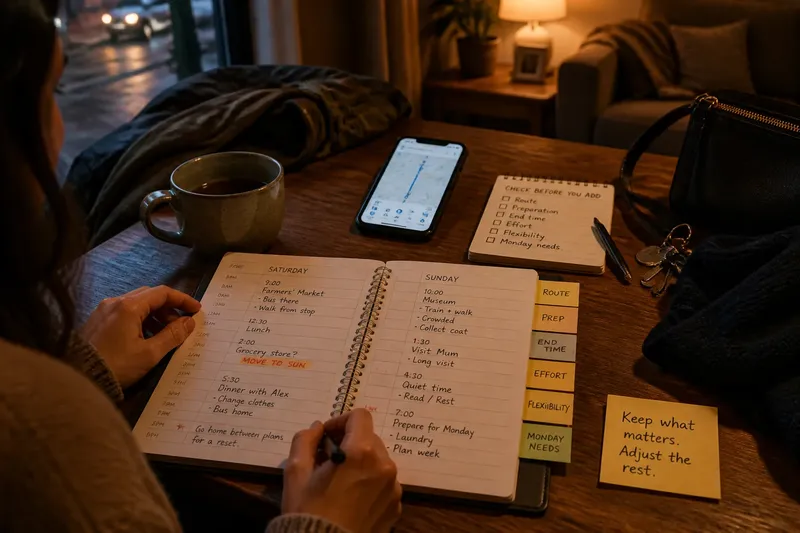
Check the actual constraints, then decide whether to keep, change or drop a plan. Each item below pairs an observation with a next move.
- Check whether the event has a fixed start time; if it does, keep it as an anchor, but if it is flexible, treat it as optional or choose a firmer plan.
- Check the route between plans in a map app; if it requires a rushed transfer, move the second plan nearby, change the travel mode or keep only one anchor.
- Check admission, transit and likely food costs against the amount you are comfortable spending; if the total feels too high, replace the paid plan with a free or lower-cost alternative.
- Check how much effort the first plan is likely to take; if it is demanding, make the second plan calmer or shorter, but if both feel manageable, keep the pairing.
- Check that everyone has agreed to each shared commitment; if someone has agreed only to the first, keep the second separate rather than treating it as a joint plan.
- Check whether the second plan adds something you want; if it does, keep it, but if it only fills a blank calendar slot, drop it and use the time for whatever suits you then.
Which two-anchor plans work for different weekends?
Can both anchors be free?
Yes. A walk in a public park and a community event can give the day structure without admission costs. Check the event’s location and start time before making it the fixed point.
What if my weekend schedule changes?
Choose anchors that can tolerate the changes you can already anticipate, such as a shift ending late or a family commitment that may move. If one plan becomes impossible, keep the other only if it still suits the day; replacing a canceled plan is optional.
How do I plan with someone who has a different budget?
Ask what kind of spending works for them before settling on an activity. A free public place or an inexpensive café can make the decision easier, but each person should be able to decline an option without having to explain their finances.
Should I book both plans in advance?
Book the plan that needs a reservation, ticket or firm meeting time. Keep the other flexible when possible, especially if it depends on weather, travel or how much energy the first activity takes.
Let the pair serve the day you actually have
A useful two-anchor day is not defined by how much it contains. It works when the plans suit your constraints and give you two reasons to look forward to the day, without making every remaining hour answer to them.
When you use the search phrase “two-anchor day” to plan a weekend, treat it as a prompt to compare commitments, not a rule about how many plans a good day requires. A pair is enough when both plans earn their place; otherwise, keep one, change the other or start with a quieter day.